The Fog is Lifting: What's Really Happening in Bay Area Real Estate
Newsletter

Newsletter
Bay Area Real Estate Report · Spring 2025 · Markets · Neighborhoods · Forecasts · Buyer Strategy
After two years of elevated interest rates, inventory whiplash, and tech industry tremors, the Bay Area housing market is entering a new — and genuinely unpredictable — chapter. Median home prices in San Francisco proper have softened, East Bay cities are defying gravity, and South Bay is riding a second AI-era tech boom. This report breaks it all down.
San Francisco real estate has always defied simple summaries, but 2025 offers a particularly sharp split: the single-family home market in desirable neighborhoods — Noe Valley, Cole Valley, the Inner Sunset — remains fiercely competitive, with sub-30-day sales and offers routinely landing 10–20% above asking. Meanwhile, the condo and high-rise market has shed eight percent year-over-year, dragged down by remote-work hangover, downtown vacancy concerns, and soft rental demand.
"San Francisco is not one market — it's a dozen. The house with a garden in Noe Valley competes the same way it did in 2021. The SoMa studio doesn't."
The divergence isn't a temporary blip. It reflects deeper shifts in what buyers — particularly families and dual-income tech households — actually want from the region. Outdoor space, parking, school proximity, and neighborhood walkability are now non-negotiable in a way that pre-pandemic buyers might have compromised on. Properties that tick those boxes are in chronically short supply.
Across the nine-county Bay Area, performance is wildly uneven. Here's a snapshot of four markets worth watching right now:
Perennially the most stable SF neighborhood. Victorian singles and modern condos both move fast. Families pay a premium for the "village" feel and top-rated schools.
Tesla HQ and BART proximity drove a surge. Inventory is thin and buyers — many of them Silicon Valley commuters — are fierce competition.
Downtown office struggles hit condo values hard. Investors looking for yield are circling, but owner-occupier demand stays soft.
The AI hiring boom has reignited demand. Multiple-offer situations are back, and sub-$3M homes routinely see waived contingencies.
Several forces are reshaping Bay Area real estate in 2025 in ways that break from historical patterns.
The generative AI wave centered in San Francisco and the South Bay has created a new class of well-compensated buyers who are relatively insensitive to mortgage rates. RSU compensation, startup equity, and signing bonuses from OpenAI, Anthropic, Google DeepMind, and dozens of smaller labs are translating into all-cash offers and aggressive bidding. The effect is most visible in a corridor from the Mission District to Menlo Park.
After 18 months of buyers waiting for rates to fall significantly, the market consensus has shifted: rates in the mid-6% range may be structural, not transitional. Buyers who locked in 2020–2021 at 3% are "mortgage prisoners," reluctant to sell and trade up. This has suppressed inventory severely — and in a supply-starved market, even softened demand keeps prices elevated.
"The locked-in homeowner effect is the single biggest reason Bay Area inventory hasn't recovered to pre-2020 levels. People don't want to give up a 3.2% mortgage."
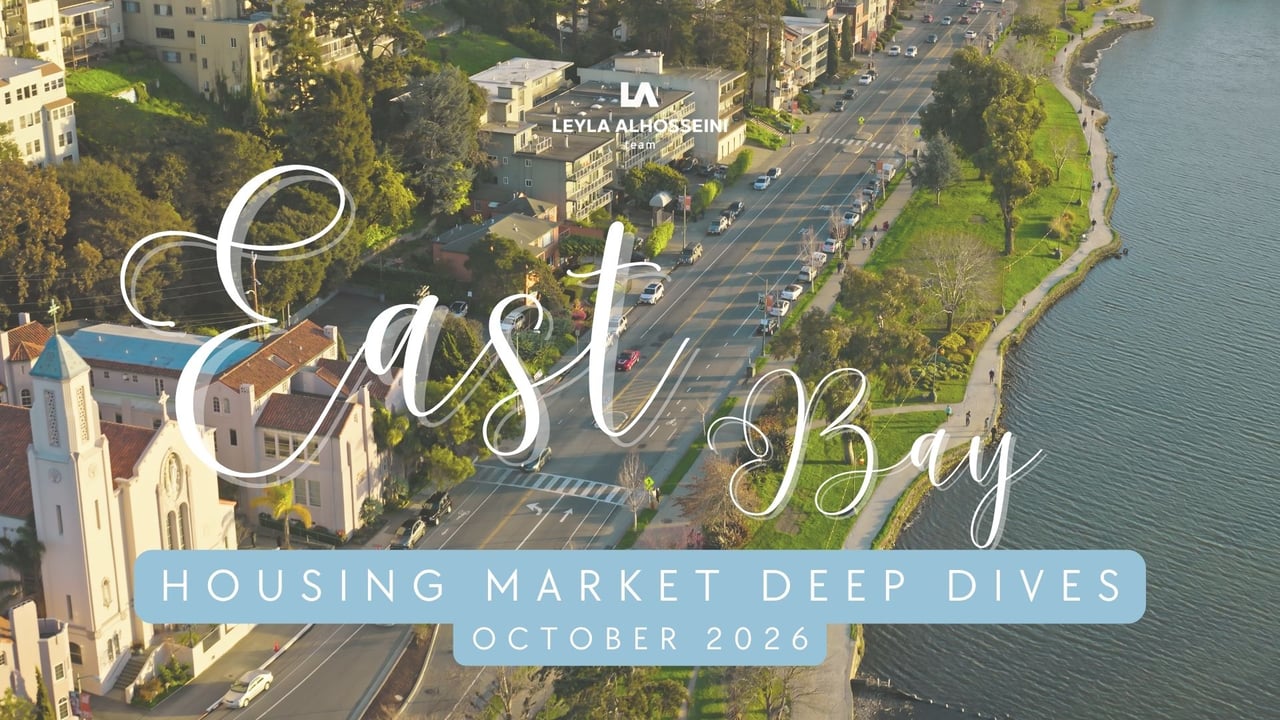
Alameda and Contra Costa counties have become the region's most dynamic market. Oakland's Rockridge, Temescal, and Grand Lake neighborhoods — long considered "compromise" buys for SF-priced-out buyers — are now destination buys in their own right. Berkeley Hills single-family homes have outperformed every SF zip code in cumulative appreciation since 2022.
What's driving it? Remote work flexibility means fewer buyers need to maximize proximity to any single office. A $1.5M Rockridge craftsman increasingly beats a $2.1M SF row house for the buyer who commutes twice a week.
The Bay Area real estate market has always operated by its own physics. In a region where the median home price is more than double the national average, where land is constitutionally constrained, where the economy can pivot on the success of a single category of technology company — normal market logic doesn't quite apply.
The current moment is defined by a paradox: housing affordability is at historic lows, yet demand in the top quartile of properties remains robust. High-income households have effectively decoupled from the rate cycle. And the region's peculiar geographic constraints — water on three sides, protected hills and parkland, exclusionary zoning in most South Bay cities — mean supply relief is unlikely to arrive in any timeframe that matters to current buyers.
California's legislative push to loosen ADU restrictions and upzone near transit has had modest effect so far. New multi-family projects have a 5-to-7-year pipeline from entitlement to occupancy, and construction costs remain elevated. The region will continue to house its workforce through price rationing, long commutes, and migration pressure until that calculus changes fundamentally.
"Calling the Bay Area market overvalued has been the most reliably wrong prediction in American real estate for forty years running."
In a market where offers are reviewed in 48 hours, a full underwrite pre-approval letter is the minimum ante. Pre-qualification is not enough to be taken seriously in a competitive situation.
Bay Area sellers disclose extensively. Read every Transfer Disclosure Statement (TDS) and Natural Hazard Disclosure (NHD) before submitting — waiving inspection contingencies requires you've done your homework.
Aggregate SF data is nearly meaningless. A Noe Valley SFH and a SoMa studio are different asset classes. Focus your comparable sales analysis to a 10-block radius and don't let city-wide headlines drive your offer strategy.
Rockridge, Temescal, and North Oakland now trade on their own merits. If you don't need SF access daily, the value gap between these neighborhoods and comparable SF properties is substantial — and shrinking.
Waiting for a 5% rate at Bay Area prices is a bet with poor expected value. The right move is to buy when the right property appears at a price that makes sense for your finances, then refinance if rates drop later.
All figures are illustrative estimates based on aggregated market analysis. This content is not financial or investment advice. For current MLS data and personalized guidance, consult a licensed California real estate professional.
Stay up to date on the latest real estate trends.

Newsletter

Newsletter
A Smart, Stress-Free Plan

Newsletter

Newsletter
Newsletter

Newsletter

Newsletter

Newsletter

Newsletter
You’ve got questions and we can’t wait to answer them.